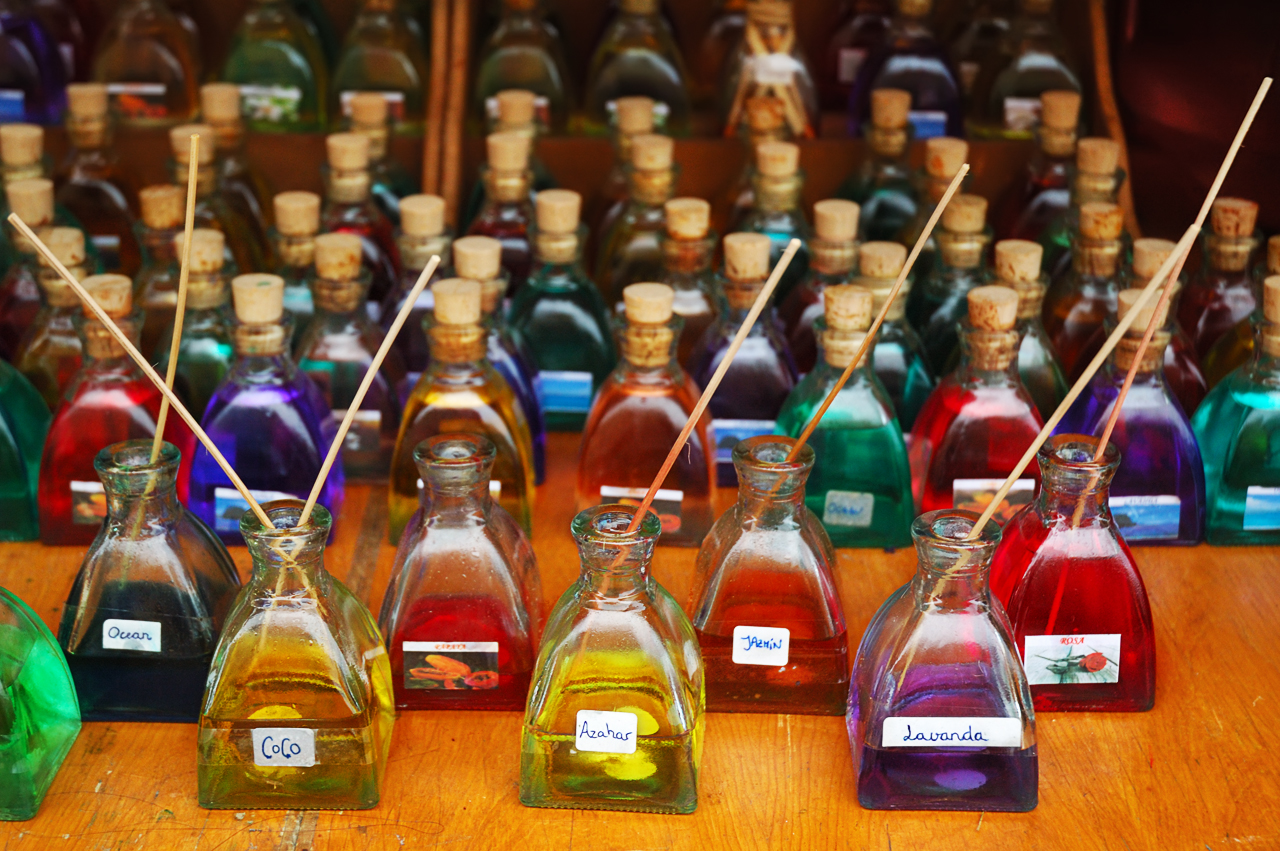
Ambient essential oils used in aromatherapy for uplifting the spirit and the mind vary in scents and colors, extracted as they are from different parts of a plant be it leaf, seed, wood, root, flower or resin among others. They have been part of alternative medicine and folk wisdom since time immemorial. That is why, it is not rare to find scented oil stands in medieval fairs around Catalonia, like this one in Vic, Osona (Barcelona Province). Here is an interesting article: Making Medieval Style Scented Oils and Waters
Opposite Ways, Passeig de Gracia, Barcelona
People come and go, establishing strange symmetries sometimes, like atoms in a formula, apparently chaotic and yet so harmonious and linked. People have lives of their own, walking in opposite ways, in opposite directions and yet they are part of the same project, human existence. Here is a good example at a pedestrian crossing in Passeig de Gracia, Barcelona.
Faculty of Medicine, Carrer Casanova, Barcelona, Spain
Although the Faculty of Medicine is located at present in carrer Casanova and has been there since 1906, the original premises were originally (1843) at carrer Carmen where the Royal Academy of Medicine is now. The 1906 building by architect Josep Domenech i Estapa, is a good example of eclectic classicism. This is a detail of the frieze that gives the building this magnificent look from every possible angle along Casanova street. Worth mentioning is the beautiful cloister inside. Notice the rhomboid figure with a hand inside to the right on the frieze: these are masonic symbols. You can check other pictures of the faculty in this album at Universitat de Barcelona official site
Vacaciones indefinidas en el blog
He decidido ponerme de vacaciones indefinidas ya que no me encuentro con la fuerza necesaria para seguir realizando artículos para vosotros.
Espero volver antes de final de temporada con un blog mejorado, podéis contactar conmigo a través de correo electrónico para darme fuerzas y nuevas ideas para la vuelta del blog.
Gracias por todo y Força Barça!
Coats, Mother and Daughter, Mercat del Ninot, Barcelona
Mother and daughter perhaps, wearing identical coats at one of the outside stands in Ninot market. This market is still in its temporary location at carrer Casanova while the old one is being restored one block away from there. A common Barcelona scene captured at random for you. I hope you like the coats.
Rabat Jewelry and Watch Shop, Passeig de Gracia 99, Barcelona
Rabat is a jewelry and watch shop in Barcelona. In fact, they have several stores in the city and more in Valencia and Madrid. This one in particular is at Passeig de Gracia 99. But the purpose of this post is not to promote their company. I am more interested in the perspective of those giant garden jars, the colors of last Christmas adornments on them and the particular Barcelona street scene depicted in the picture. As with many street photographs you may interpret whatever you like here and imagine your own story. To me maybe it will make sense after some years. I enjoy watching old images cause I think that like wine they get better with time.
Los gunners disparan primero
ARSENAL FC 2-1 FCBARCELONA
Y por fin volvía la Champions, después de unos meses de descanso en los que la Liga y la Copa era lo importante llega la etapa verdaderamente importante de la temporada, en la que la mejor competición en juego comenzaba su fase definitiva. El Barça viajaba a Londres después del tropezón liguero ante el Sporting, esta vez jugarían los jugadores de gala, excepto Puyol que no llegó a tiempo para disputar el partido, así pues Guardiola alineó a: Valdés; Alves, Piqué, Abidal, Maxwell, Xavi, Busquets, Iniesta; Pedro, Messi, Villa. El partido contaría con el morbo especial de ver ante su equipo del alma a Cesc Fábregas, que esta vez sí que podría jugar contra el Barça, después de no poder hacerlo en la temporada pasada.
Primeros minutos de partido para meter el susto en el cuerpo, el Arsenal llegaba con mucho peligro en las primeras acciones del partido, con unas contras letales que si no llegaba a ser por Valdés podían haber sido gol perfectamente. Tras el paso de los minutos podíamos ver que el Arsenal presionaba muy arriba al Barça, a pesar de que el Arsenal entregara la posesión a los azulgrana no conseguían mover el balón cómodamente, lo que les costaba pérdidas de balón y peligro en las contras realizadas por la velocidad de los gunners. Por lo menos podíamos ver como los pases al hueco en ultima línea funcionaba perfectamente, lo que dio la primera gran ocasión del Barça, después que recibir el pase consigue hacer un gran amago al portero, y la pica perfectamente por encima, pero el balón acaba rozando el poste de la portería de Szczesny. En el minuto 26 el Barça lo volvió a intentar de la misma manera, con un gran último pase al hueco por parte de Messi que encuentra a Villa, y éste queda sólo frente al portero, superándolo metiendo el balón entre sus piernas y anotando el 0-1, gran gol del asturiano, el 2º en esta Champions. Las oportunidades no cesaban por parte de los dos equipos, el Barça no copaba el protagonismo ofensivo al que nos tiene acostumbrados, el Arsenal estaba realizando un buen trabajo a la contra. En el minuto 37, el juez de línea se inventó un fuera de juego de Messi que cabeceaba el balón dentro de la red, el asistente interpretó que Leo estaba más adelantado que Villa en el momento del pase, pero la repetición muestra el error garrafal del linier. Y hasta ahí transcurrió la primera parte, el Barça se llevaba hasta el momento el duelo de pistoleros en el Emirates Stadium.
La segunda parte comenzaba con unos primeros minutos de ataque gunner, pero el Barça recuperó poco a poco el balón y lo empezó a manejar a su antojo, haciendo que el Arsenal volviera a las contras tan peligrosas de la primera parte. En el minuto 56 Koscielny agarró a Pedro dentro del área, pero ni el árbitro ni el juez de área vieron el agarrón del defensa al canario. Poco después, Piqué vio la tarjeta amarilla que le va a hacer perderse la vuelta del partido en el Camp Nou, tras una tarjeta merecida. El Arsenal iba despertando poco a poco haciendo bajar las líneas del Barça mientras ellos subían las suyas poco a poco, haciendo que el peligro sea todavía superior. Guardiola optó por meter músculo y meter a Keita por el autor del gol de la noche, Villa, en mi opinión Pedro debía haber sido el intercambiado, ya que no estaba siendo muy afortunado de cara al gol. Y tras tanto ataque gunner finalmente llegó lo buscado, tras una internada de Van Persie, y tras el amago a Piqué, el holandés lanza el balón al palo en el que estaba Valdés, pero el azulgrana no cubre nada bien el palo al perder la referencia con él, y lo deja libre, dejando a placer la trayectoria del balón al fondo de las mallas, haciendo así el 1-1 en el marcador. Tras 5 minutos de toque innecesario del Barça el Arsenal realizó otra jugada por medio de Nasri, que encuentra la internada de Arshavin y el ruso consigue disparar al palo largo de Valdés, haciendo el 2-1 en el marcador y consolidando la remontada en el Emirates. El Barça había tirado por la borda el triunfo por la mal colocación defensiva, lo que muestra y engrandece la falta de Puyol en el campo, ya que el capitán siempre corrige ese tipo de errores. Casi al final de partido, Guardiola realizó otro cambio no muy acertado, ya que quitó a Iniesta para dar entrada a Adriano. En los últimos minutos el Barça lo intentó de todas maneras, pero el Arsenal estaba replegado al completo en su área, dando por bueno el marcador, que finalizó con 2-1. Partido que en verdad el Barça no se mereció perder ya que manejó el partido en toda la primera parte y en parte de la segunda, pero unos malos minutos y la fortuna rival le dieron la vuelta al partido, por suerte, el gol fuera de casa vale doble y el 1-0 en el Camp Nou daría el pase a los de Guardiola, por lo que hay que ser optimistas para el partido de vuelta.
Medicinal Herbs and Other Alternative Remedies
The miracle cure, the panacea so much sought after in the history of mankind and yet so unattainable and utopic. I always wonder who was the first one to put a particular plant on a kettle to make an infusion or prepared a cataplasm to apply on wounds or simply decided to chew up some leaves after watching animals react (well, it happened with coffee berries anyway!) How many anonymous individuals probably dropped dead after doing that and exclaimed in the last moments of agony - wrong leaf, forget about this one! Here are some samples of medicinal herbs at a local medieval fair in Vic. I don't know the name but it is indicated in the treatment of a swollen liver or hepatitis (fetge means liver in Catalan). A good example of old remedies for liver illnesses would be Anemone hepatica or hepatica nobilis.
Cupcakes (Magdalenas) at Local Market Stall
I am not fond of cupcakes (magdalenas in Spanish) because I find the dough too dry to swallow. But there is a huge difference between those industrial magdalenas packed in plastic at the supermarket and homemade Spanish cupcakes right out of the oven. In Catalan towns it is common to find these local fairs where you can buy all sort of homemade products so rare in big cities like Barcelona and cupcakes are one of them. Today's picture was taken in Vic. Here is an easy Spanish cupcake recipe
Un punto "preciado" para el final de temporada
SPORTING DE GIJON 1-1 FCBARCELONA
El Barça viajaba a Gijón después del partido de selecciones, habitual síntoma de pérdida de puntos por el conocido virus FIFA, y partido previo al esperado choque contra el Arsenal en Champions, por lo que Guardiola optaría por hacer rotaciones en el once titular, alineando a: Valdés; Alves, Piqué, Milito, Maxwell; Xavi, Mascherano, Iniesta; Afellay, Messi y Villa. El Molinón recibió a su equipo con un gran mosaico con los colores rojiblancos del Sporting, a la vez que cantaban el himno del club.
El partido comenzaba con posesión favorable al Barça pero con el ritmo de juego más lento de lo que nos tienen acostumbrados. El Sporting estaba bien ordenado en defensa y realizaban bien los contraataques, creando mas peligro de lo esperado sobre la portería de Valdés. El partido transcurría sin ninguna ocasión clara de gol hasta el minuto 16, cuando el Barça perdió el balón en el centro del campo, y Barral consiguió acercarse al área y hacer el lío a Piqué, y Milito no impidió el disparo de Barral, que lanzó un gran disparo al palo largo, superando a Valdés y poniendo el sorprendente 1-0 en el marcador. Después de esto, el Sporting optó por dejar los contraataques y centrarse en defensa. El Barça notaba la falta del ataque por las bandas, Alves no se dejaba ver y se notaba, además, se notaba la falta de Busquets, ya que se veían muchos errores con balones perdidos en el centro del campo. El primer tiro a puerta favorable al Barça se produjo en el minuto 34, lo que mostraba que este Barça no es el mismo de siempre, Iniesta lo intentó después de driblar a la defensa, pero Cuellar consiguió detener el balón. El juego seguía espeso en todas las líneas azulgranas y el Sporting estaba realizando un gran partido, y el partido llegó al descanso con 1-0 en el marcador.
En el descanso se realizó el primer cambio azulgrana, Afellay, que no estuvo bien, fue sustituido por Pedro, para mejorar el ataque por las bandas. El Barça pareció salir más enchufado en la segunda parte, con el juego un poco más rápido y ofensivo que en la primera. En el 52 pudo llegar el empate tras una gran centro de Alves hacia Xavi, pero Cuellar consiguió despejar el balón. Se notaba la mejora ofensiva gracias a la aparición de Alves y Maxwell por las bandas, lo que propiciaba buenas ocasiones de gol. Guardiola decidió realizar un cambio, sacando a Keita por Milito, renunciando a la defensa de 4 ya que el Sporting no atacaba.
El árbitro estaba tarjetero en este partido, sacando amarillas a los azulgrana por cualquier cosa, incluso Pinto acabó con tarjeta amarilla, aun estando en el banquillo, también Pedro se encontró con la tarjeta tras recibir una tarjeta, aunque la amarilla fue resultado del enfado del canario, Xavi también se encontró con amarilla tras una leve entrada a Barral, que le echaba cuento para perder tiempo. Y al fin llegó el premio para el Barça, en el minuto 80 apareció Messi en el centro del campo, y tras driblar a los rivales logra un gran pase para Villa, que ve a Cuellar adelantado y pica el balón, anotando un golazo de nuevo ante su equipo, razón por la que no celebró el gol. En el 87 el Barça pudo darle la vuelta al partido, después de que Messi realizara un buen centro cerca del área pequeña hacia Pedro y Villa, pero el canario que se lanzó hacia el balón golpeó mal, y se perdió por muy cerca de la portería asturiana. Piqué no estaba realizando ni mucho menos su mejor partido defensivamente, y estuvo a punto de costarle el segundo gol en contra, después de ceder mal el balón, la acción le costó a Valdés la amarilla por encararse con el delantero. El árbitro añadió 5 minutos que hacían soñar a la aficion azulgrana, y a punto estuvo de culminarse el sueño, ya que Xavi realizó un gran tiro desde la frontal del área hacia la escuadra, pero Cuellar realizó una espectacular parada que desvió el balón a córner. Los siguientes minutos transcurrieron sin ninguna acción, ya que Cuellar perdió 1 minuto y medio tras quejarse de un golpe en la boca que nunca sucedió, con lo que el partido concluyó con 1-1, un punto que corta la racha de 16 victorias consecutivas, además con este empate el Barça cede los 2 primeros puntos fuera del Camp Nou.
The History of FC Barcelona
FC Barcelona, or Futbol Club Barcelona, is a sports club based in Barcelona, Spain. Though it is primarily known for its football club, FC Barcelona also consists of four other professional sports teams, competing in basketball, handball, futsal, and roller hockey. FC Barcelona, known familiarly by its fans as Barça, has been around for over one hundred years and has been consistently popular throughout.
FC Barcelona was founded in 1899 by Joan Gamper, a Swiss businessman who had relocated to Spain after falling in love with the country. Gamper sought to start a football club and placed an ad in a paper, receiving several responses and quickly assembling a team that went on to emerge as one of the leading teams in their home region of Catalonia and the greater country of Spain. In 1902, the club won the Copa Macaya.
In 1908, Gamper became club president in order to save the club from going under. FC Barcelona had been experiencing hardships due to many of their best players retiring and the fact that they had not won anything since 1905. Gamper was able to get the club its own stadium, formally moving into the Carrer Industria on March 14, 1909. Gamper was also able to recruit top-notch players and managers and get the club back into the business of winning with him at the helm. The club moved yet again in 1922 to an even larger stadium, Las Cortes, which eventually had a capacity of a whopping 60,000.
The mid- 1920s and 30s marked a period of hardship for the club. During this period, a crowd at a Barça game jeered the Royal March as a spontaneous objection to Spain's dictatorship. As a result, the stadium was shut down for three months and Gamper was forced to concede the presidency of the club. The club's founder committed suicide on July 30, 1930 following a bout of depression brought on by personal and financial problems.
After the Spanish Civil War, Dictator Francisco Franco banned football clubs from using non-Spanish names. As a result, FC Barcelona was changed to Club de Futbol Barcelona. During this period, the club was oppressed by Franco's regime, which favored their rivals, Real Madrid. Despite the political climate and oppression, FC Barcelona was able to go on and win many trophies and championships during the 1940s and 50s.
Though they became the first club to beat Real Madrid in a European Cup eliminatory in 1961, the 60s were not a great decade for CF Barcelona. Because the club lacked money to acquire better players after building a new stadium, the league was dominated by Real Madrid and Atletico Madrid. The 1970s, however, saw the arrival of the soon-to-be-legendary Johan Cruyff, who led the team to the championship in '74.
Despite winning many championships, the next fourteen years saw the team experience conflicts with their management. Finally, in 1988 Johan Cruyff returned as team manager and assembled the "Dream Team", a group of elite players. Cruyff led the team to many victories and remains their most successful manager to date. After Cruyff's departure in 1994, managers and players came and went, but the team continued having limited successes.
Finally, in 2003 a young new president took over FC Barcelona. Joan Laporta brought in manager Frank Rijkaard and many international stars that led the team to many victories for a few years. In 2008, after many failures Laporta decided to replace Rijkaard with Barça B coach Josep Guardiola.
To see first hand how Barca does with their new lineup, see them play at the Nou Camp in Barcelona. Buy FC Barcelona tickets in advance from Simply Barcelona Tickets to ensure ticket availability
Article Source: http://EzineArticles.com/?expert=Mark_Hazard
FC Barcelona Players - Lionel Messi
If any player can be said to be the natural successor to Diego Maradona, then surely it must be Lionel Messi.
Born in 1987, he signed for Barcelona from Newell's Old Boys of Argentina at 13 years of age, and since that time Messi has been marked for super stardom. But for a niggling succession of injuries, he surely would have been a Ballon D'Or winner by now.
What has always singled out 'Leo' as being special is his ability to dribble at speed with the ball under perfect control. Although primarily a winger, he can play more central or even deeper but, whatever his position, when he has the ball at his feet, the fans always expect something special from him.
Since scoring his first league goal for Barça in May, 2005 Messi has become a talisman for the team - his modest attitude off the pitch and his constant praising of the work of his team mates ensuring that the fans always hold him in the highest esteem.
Life wasn't always easy for Messi, though, despite his prodigious talent. As a youngster, Lionel suffered from a growth preventing hormonal disorder - Barcelona helped tempt him to Spain by paying for his medical treatment. This short stature, ironically, has enabled Leo to have that low centre of gravity that enables him to weave through defences.
Despite being wooed by the Spanish national team, Messi has always been eager to represent the country of his birth - he was voted player of the tournament in the Under 20 World Cup in 2005, where he was also top goal scorer. In the 2007 Copa America he was voted young player of the tournament. He was not afraid to let it be known how desperate he was to represent Argentina in the 2008 Olympic Games and although Barcelona appeared reluctant at first to release him, he ultimately helped Argentina win the gold medal - creating the only goal of the final in the process.
Playing for the national team hasn't brought constant success, however. On his international debut, against Hungary in 2005, Messi came on as substitute in the second half and was sent off 40 seconds later - allegedly elbowing the defender who was tugging his shirt to hold him back. Then, in the 2006 World Cup, Pekerman, the coach, was the subject of immense criticism from fans because of his seeming reluctance to play Messi in what was, for the Argentines, a disappointing tournament.
And those Maradona comparisons? Well, the great man himself did say at one point that Messi was his natural heir. And if you want to see a carbon copy of the 'hand of God' goal then search on You Tube for Messi's 'goal' in June, 2007 - against Espanyol in a local derby, would you believe!
While you're there, though, remind yourself as well of the goal against Getafe in the Copa del Rey, when the little maestro picked the ball up and ran through just about the whole team to round the keeper and score. If that doesn't bring back memories of Maradona then nothing will.
Despite the comparisons, Lionel Messi isn't the second Maradona. A modest, cool-headed, softly-spoken personality, Lionel Messi never seems to find himself in the gossip columns. Instead, he just gets on with the job of trying to be as good a footballer as he can be: and that is as good as any forward player in the world game.
Lionel Messi is a great player in his own right. And he can only get better.
Ensure that you see Leo Messi playing for FC Barcelona at the Nou Camp and order FC Barcelona tickets online. Check out Simply Barcelona Tickets for details.
Article Source: http://EzineArticles.com/?expert=Mark_Hazard
Barcelona FC - the Most Famous Football Team on the Planet?
With its avid fan base - known as the culés - and a motto that declares, "El Barca es mes que un club," the Barcelona FC would appear to have a lot to live up to when it comes to its reputation. It is safe to say, though, that Barca - as it is typically referred to by football fans - is the most successful football team on the planet today. With a rich history spanning back to the year 1899, and strings of successes that leave many other clubs in the dust, Barcelona FC offers football adherents a roster of the top stars in the game, consistent excellence and a level of excitement that is unmatched by virtually any other major sports team in the world.
A Tradition Of Excellence
The Barcelona football club was founded in the year 1899 by Joan Gamper and a group of Spanish, Swiss and English men. Almost immediately, the Barcelona FC emerged as one of the top football clubs in Spain; it was off to a marvelous start, to say the least. Despite this early success, though, the club nearly folded early on; Gamper took over as president in 1908 and helped steer the club back towards success. Under his leadership, Barcelona FC secured its first stadium and started accumulating a number of impressive victories.
Surviving Through Thick And Thin
The twentieth century was a tumultuous one, and between many key victories the Barcelona FC had to grapple with the Spanish Civil War as well as two World Wars. Despite it all, though, Barcelona FC came out on the other side with a truly phenomenal team. With the signing up of Dutch phenom Johan Cruyff in 1973, Barcelona FC rocketed to unprecedented heights. Since that time, the club has essentially been unstoppable. Star players - including Maradona, Lineker, Figo, Stoitchkov and Rivaldo - have all done their part to create some of the most passionate fans in the world of football.
Strong Evidence Of Success
Beyond their many electrifying victories and long lines of top rates players, Barcelona FC has enjoyed more accolades than seemingly any other football club in the world. Hotels in Barcelona book up quick when the team plays at the 98,000-person capacity Camp Nou. The International Federation of Football History and Statistics named the club the most consistently successful one since statistics have been kept. It's little wonder that Barcelona hotels fill up when the team plays, considering its first place UEFA ranking and many other key achievements.
Immerse Yourself In Barcelona FC Pride Firsthand
Ardent fans of the Barcelona FC - and there are millions of them - can revel in the club's glory by visiting Club Nou and touring the premises. By booking hotels in Barcelona, visitors can head over to Europe's largest stadium and enjoy one of two different self-guided tours. There is also a fascinating museum on the premises, where fans can observe the club's many trophies up close and personal. If you want to see all of this for yourself, book Barcelona hotels and plan a trip to the home of football's most successful team.
Eoin has written for many publications in his native south Wales and further afield. He currently lives in London's trendy Docklands with his partner. Both are regular faces in West End theatre audiences.
Article Source: http://EzineArticles.com/?expert=Eoin_Evans
Lionel Messi - The Greatest Contemporary Footballer
Is he the greatest contemporary footballer in the game today? Many might argue that yes, Lionel Messi is the greatest. After all, fans and foes have often drawn lines of comparison between Messi and his hero, the legendary Deigo Maradona. Add to that the ultimate compliment offered up by Maradona himself, who stated Messi would be his "successor", and it's kind of hard not to at least notice that Lionel Messi is one amazing footballer.
As a striker/winger for Barcelona and a member of the Argentine Senior International Team, Messi made his debut with Barcelona during the 2004/05 Season and broke La Liga's record for being the youngest player to ever score a league goal. The young striker's aggressive play and sheer athleticism powered him to a spot as a first team regular in Barcelona in 2006/07, when he scored 14 goals in only 26 league games. Then, as if to raise the bar for himself, he went on to score 38 goals in Barcelona's incredible 2008/2009 Season.
As a top scorer in the 2005 FIFA World Youth Championship, he soon became an established player in the Argentine Senior International Team. As part of that squad, Messi became the youngest Argentine player ever to participate in a World Cup match in 2006. Later, in 2008, he was part of the Argentine Olympic squad and was honored with a gold medal for his efforts in the Beijing Games.
Beloved of fans on the field, he also deserves kudos for his charitable efforts off the field, too. In 2007, Messi establish the Fundacion Leo Messi (Leo Messi Foundation). The charity supports access to both education and health care for children in at risk situations. Likely a response to his own childhood illness, Messi makes sure the foundation supports assistance for Argentine children diagnosed with difficult medical conditions by offering them advanced treatments in Spain and covering their expenses including transportation, hospital stay and rehabilitation. He is partnered with the company Herbalife in this endeavor. In March of this year, Messi became a goodwill ambassador for UNICEF, at least partially due to his personal efforts on behalf of children's rights.
For further details please visit: http://www.footballcraze.contentcreatorz.com/
Are you all crazy about football and looking for some interesting posts on football? http://www.footballcraze.contentcreatorz.com/ is the perfect place for you!
Article Source: http://EzineArticles.com/?expert=Maira_Sarfraz
Lionel Messi's Goal of the Century - FC Barcelona v Getafe
While many FC Barcelona football tickets are bought by those wanting to see the marvels of Ronaldinho and Eto'o at the Nou Camp, one of the most exciting young players to regularly grace the line up of FC Barcelona is the Argentinean player Lionel Messi.
While highly regarded in the Nou Camp, his profile has been lower than the two previously mentioned players until now; but perhaps the beginning of the end of his relative low-profile happened last week when he scored an amazing goal in a match against Getafe in the Copa del Rey - the King's Cup.
The match - in which Barcelona beat Getafe 5-2 - saw two goals from Messi, as well as Xavi, Eto'o and Gudjohnsen, but it is the Messi's first goal in particular that people are talking about nearly a week after the event.
In an almost move for move reproduction of Maradona's "goal of the century" against England in the 1986 World Cup semi-final - English fans will never forgive Maradona scoring off a handball in the same match, dubbed by Maradona himself as "the hand of God" - Leo Messi received the ball from Xavi, beat a total of five Getafe players and then knocked the ball past the goalkeeper into the net, running a distance of 63 metres in doing so.
Naturally Messi is being compared with Diego Maradona, to whom he dedicated the goal, and if you watch the two goals side by side the similarities are eerie.
Although Messi's star is currently shining bright, the future for the young player was at one time looking bleak. Diagnosed with growth hormone deficiency when he was eleven years old, a time when the Argentinean economy was in meltdown, neither his family nor the club that had expressed an interest in him, Club Atletico River Plate, were unable to afford the treatment.
However, his family jumped at the chance of starting a new life in Spain when Catalan giants FC Barcelona stepped in with an offer that included all medical expenses and he quickly flourished in Barcelona's youth team. Since becoming a first team regular he has become a firm favourite and puts his talent to good use against some of the top teams in the league, including arch-rivals Real Madrid.
Although the comparison with Maradona unfair at this early stage in his career, providing Lionel Messi can remain motivated and injury free then he could easily join the ranks of the football greats.
For information and online booking of Barcelona football tickets at the Nou Camp visit http://www.simplybarcelonatickets.com
Article Source: http://EzineArticles.com/?expert=David_Leigh
Subscribe to:
Posts (Atom)


